
 RFID gate
 Traceability
 Paperless production
 About us
 Partner
 Contact
Advantages of RTLS
![[Translate to English:] Icon Echtzeit-Tracking](/fileadmin/AutoID_RFID/rfid-tracking/traceability/icon_rueckverfolgbarkeit.png "[Translate to English:] Echtzeit-Tracking")
RTLS enables the continuous monitoring and localization of objects in real time, which is essential for time-critical applications.
![[Translate to English:] Icon Genauigkeit](/fileadmin/AutoID_RFID/rfid-tracking/RFID-Gate/genauigkeit_icon.svg "[Translate to English:] Genauigkeit")
RTLS systems are characterized by exceptionally high localization accuracy, especially indoors, where technologies such as GPS reach their limits.
![[Translate to English:] Icon Ortung](/fileadmin/AutoID_RFID/rfid-tracking/traceability/icon_ortung.png "[Translate to English:] Ortung")
RTLS is particularly suitable for dynamic environments in which objects or people are constantly moving and continuous localization is required.
![[Translate to English:] Icon Effizienz](/fileadmin/AutoID_RFID/rfid-tracking/RFID-Gate/Kostenerspranis.svg "[Translate to English:] Effizienzsteigerung")
The precise and timely localization of objects or persons can optimize operational processes, increase safety in the workplace and ultimately reduce costs.
How RTLS works
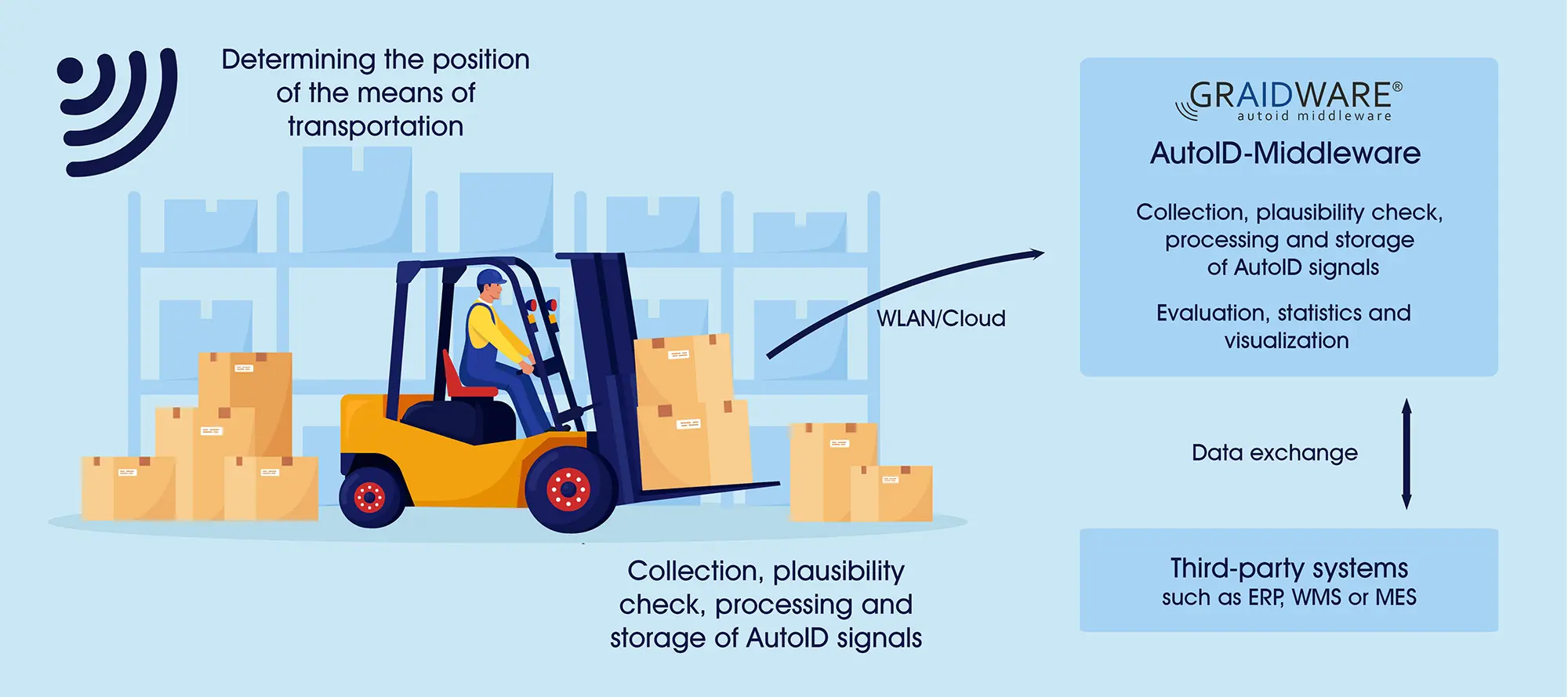
The technology that is often used in an RTLS is ultra-wideband (UWB). UWB enables the precise and contactless localization of RTLS tags by measuring signal propagation times. The RTLS tags, which are equipped with their own power source (usually a battery) and are therefore permanently active, continuously emit signals. These signals are received by RTLS anchors, which then determine the exact position of the tags in the room in real time.
In a typical RTLS setup, multiple RTLS anchors or antennas could be installed in a defined area to monitor the movement and location of tagged objects. When a tagged object enters or leaves an area monitored by an RTLS anchor, an event is generated. This event contains information about the time and location of the tag detection. By analyzing these events, the system can determine the current location of the object and track its movement within the monitored area.
An RTLS can be used in various applications, for example in logistics to monitor the movement of goods in a warehouse, in production to track the progress of workpieces through a production line, or in hospitals to know the location of medical equipment or personnel. However, it should be noted that RTLS tags are generally larger and more expensive due to their active technology, which limits their use to areas with high requirements for real-time localization and precision.
The data collected by the RTLS can be used for various purposes, such as optimizing workflows, improving inventory management or increasing security by monitoring access areas.
In summary, an RTLS is a powerful tool that enables precise real-time monitoring and localization of objects.
Comparison of RTLS with other positioning technologies
Comparison of RTLS with RFID
RFID is an established technology for identifying objects and recording data that is often used for tracking goods. RFID systems usually require permanently installed reading points to capture the tags.
RTLS, on the other hand, enables continuous real-time location and is not dependent on fixed reading points. This offers the advantage that objects can be located dynamically and with high accuracy within a defined area.
The combination of both technologies - RFID for reliable identification and RTLS for real-time localization - enables comprehensive, precise tracking and meets specific tracking requirements.
Comparison of RTLS with GPS
GPS (Global Positioning System) provides global positioning and is ideal for navigation and tracking vehicles or people outdoors.
RTLS, on the other hand, is specifically designed for indoor spaces and environments where GPS signals are unavailable or unreliable. RTLS systems can provide precise localization within buildings, which can be critical for applications such as operations optimization, workplace safety or tracking.
RTLS offers specific advantages over other location technologies such as RFID and GPS, particularly in terms of real-time location, accuracy and indoor applicability. These characteristics make RTLS a valuable technology for a variety of applications where precise and timely location information is required.
Increased efficiency and transparency thanks to RFID and real-time tracking at Ortrander Eisenhütte
Ortrander Eisenhütte was looking for a solution to optimize search times and increase efficiency in production and storage processes. A central concern was also to have an overview of the status of individual work steps in production at all times. Digitizing the work processes would create significant added value for the company.
Following its own investigations, Ortrander Eisenhütte determined that a solution was only possible by using UHF RFID technology in combination with a real-time location system (RTLS). The company decided to work with SIGMA Chemnitz GmbH to implement the project.
1. identification of the products after casting:
After casting, the products are stored in transport containers. During this work step, each load carrier receives an RFID tag that has already been linked to the model produced and additional important data.
2. data collection and management:
All collected data is merged and managed via the GRAIDWARE® middleware. At a transfer point, the products are transferred from production for further processing, whereby the weight is also documented and transmitted to GRAIDWARE®.
3. position documentation in block storage:
When products are stored in the block storage system, the position of the forklift truck is documented and thus the storage position in the block storage system is determined. The position is also recorded when products are removed from the block storage area and transported to a processing station.
4. transparent process evaluation
Each work step is documented transparently in GRAIDWARE® so that the entire process from production to storage to further processing can be traced.
The combination of RFID and RTLS enabled Ortrander Eisenhütte to significantly increase the efficiency of its warehouse and production processes and achieve a comprehensive overview of the status and location of its products.
More efficient decisions through real-time analyses
Real-time location systems (RTLS) offer a wide range of possibilities for using collected data to make informed decisions. The continuous recording of locations and movements of objects provides valuable information that can help to identify patterns and trends. For example, it is possible to analyze how often and how long certain machines are in use in order to proactively adjust maintenance schedules and maximize uptime.
Visual dashboards offer a comprehensive display of the most important key figures at a glance. For example, a dashboard could display the current position of all vehicles in a warehouse or graphically represent the capacity utilization of various production lines. This overview makes it easier to make operational decisions quickly and in a targeted manner.
The collected data and analyses are structured and summarized in reports to provide detailed insights into operations. Regular reporting enables companies to monitor the performance of their processes over defined periods of time and document progress - such as efficiency gains since the introduction of an RTLS. Such reports provide a sound basis for strategic decisions and help to clearly evaluate the achievement of objectives.
By combining RTLS with comprehensive analysis and reporting tools, companies can take targeted measures to increase efficiency, improve security and reduce costs. Real-time analyses thus support proactive and data-based optimization of all operational processes.
We will be happy to present solutions for your industry and your processes. Talk to the specialists for SMEs.
request now
