
 RFID gate
 Traceability
 Paperless production
 About us
 Partner
 Contact
One-piece flow compared to traditional batch production
Feature | Batch Production | One Piece Flow |
Production method | Batch production | Single piece runs through the chain |
Lead time | Waiting times between processes | Continuous flow |
Warehousing | High interim stocks | Direct processing with little buffer |
Error detection | Later in the process | Immediately at the station |
Flexibility | Changes only after the batch | Possible directly during the ongoing process |
Expenses | Higher due to stock and rework | Reduced effort and waste |
Product recall | Recall of the entire batch, often including unaffected parts | Recall only of the specific parts affected |
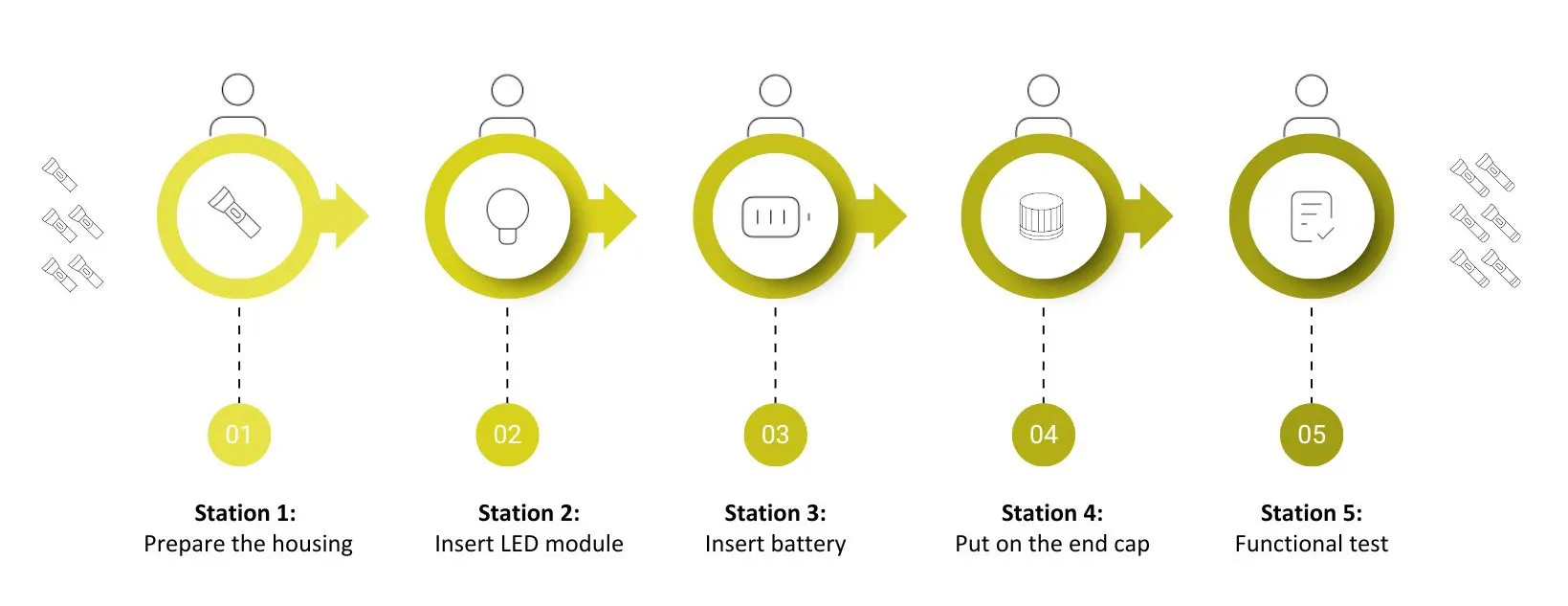
RFID makes one-piece flow transparent and controllable
In a continuous production flow, no part must be lost. RFID ensures that every workpiece can be identified at all times—automatically, without manual scanning.
How RFID supports one-piece flow:
- Unique identification of parts, e.g., by means of a master part with RFID tag
- Automatic detection at each station
- Live data on position, processing status, and cycle time
- Real-time overview of production progress
- Early detection of delays or malfunctions
This data flows directly into dashboards, systems, or notifications—helping to keep the flow stable.
Paperless manufacturing as the basis for a stable flow
One Piece Flow only works well if information is available where it is needed. And if it is up to date. In paperless manufacturing, that is exactly what happens:
- Digital work instructions directly at the terminal
- Visual support for workers, depending on the product, order, or variant
- Immediate feedback in the event of quality deviations
- Seamless communication between work steps—no running cards or forms required
This creates a continuous flow – transparent, traceable, and controllable.
Terminals support workers in the flow
![[Translate to English:] Carthago](/fileadmin/Referenzen/AutoID_RFID/carthago_web.webp "[Translate to English:] Werker-Terminal")
In a one-piece flow environment, workers are often on the move. It is important that information remains available at all times. Our solution: mobile or stationary terminals at each station.
Advantages:
- Clearly structured process steps – even with a wide variety of variants
- Error prevention through digital instructions
- Direct entry of feedback or checks
- Support for new employees through illustrated content
The terminals are not only used for guidance, but are also an important source of data. All recorded information flows back into the system for evaluation, tracking, and continuous improvement.
Fewer storage locations thanks to automatic consumption booking
Material consumption is recorded where it occurs—automatically, without scanning or paperwork. This not only reduces the error rate, but also saves space and makes the flow of materials visible.
Advantages:
- Lower inventory levels on the line
- Transparent material availability
- Faster replenishment processes
- Prevention of incorrect bookings
Advantages of RFID and paperless manufacturing in one-piece flow
This method offers many advantages. At the same time, it requires a solid foundation. Here are some typical challenges—and what it takes to overcome them.
Area | Benefits for the process |
Tracking | Live status of each part visible, less downtime |
Error detection | Detect faults early and rectify them in a targeted manner |
Supply of materials | Automated bookings and real-time triggering |
Quality control | Feedback directly on the product and at the terminal |
Quality deviations | Trace deviations at the individual part level, identify trends early on, and take targeted action |
Traceability | Complete history at item level |
Worker support | Clear information, fewer misunderstandings |
Order control | Changes possible until shortly before the work step, digital interventions without search effort or paper processes |
RFID in one-piece flow: managing rush orders and prioritization
In a traditional process, rush orders are often disruptive. In one-piece flow—with RFID and real-time data—the system can immediately classify the order and dynamically reprioritize resources:
- Detect available stations
- Check material status
- Transfer without waiting or conflicts
- Automated adjustment in the background
This drastically reduces the response time to special orders and ensures that the overall process remains stable.
Challenges – and how digital systems can help
One-piece flow is challenging. Especially with low buffering, many variants, or changing orders, you need reliable data and a system that responds in real time. Our technology helps with this:
- RFID prevents gaps in material flow
- Dashboards show bottlenecks early on
- Terminals bring information to where it is needed
- All data is collected centrally – for analysis, tracking, and optimization
Without this digital foundation, the flow remains vulnerable. With RFID and paperless control, it becomes stable, traceable, and controllable.
Conclusion: One Piece Flow requires a digital foundation
One Piece Flow is a powerful concept—but it only works if processes run smoothly and data flows digitally. We provide the technological basis for precisely that.
With RFID, real-time tracking, terminals, and paperless control, we make complex manufacturing processes leaner, safer, and more responsive.
We will be happy to present solutions for your industry and your processes. Talk to the specialists for SMEs.
request now
