
 RFID gate
 Traceability
 Paperless production
 About us
 Partner
 Contact
For which applications is direction detection relevant?

Recording and monitoring the flow of goods

Recording and booking of labeled goods upon delivery

Recording and booking of goods to be delivered

Recording of goods transitions between several halls on one site

Recording of material movements between different production areas

Transfer of goods or goods carriers between locations
How does direction detection work?
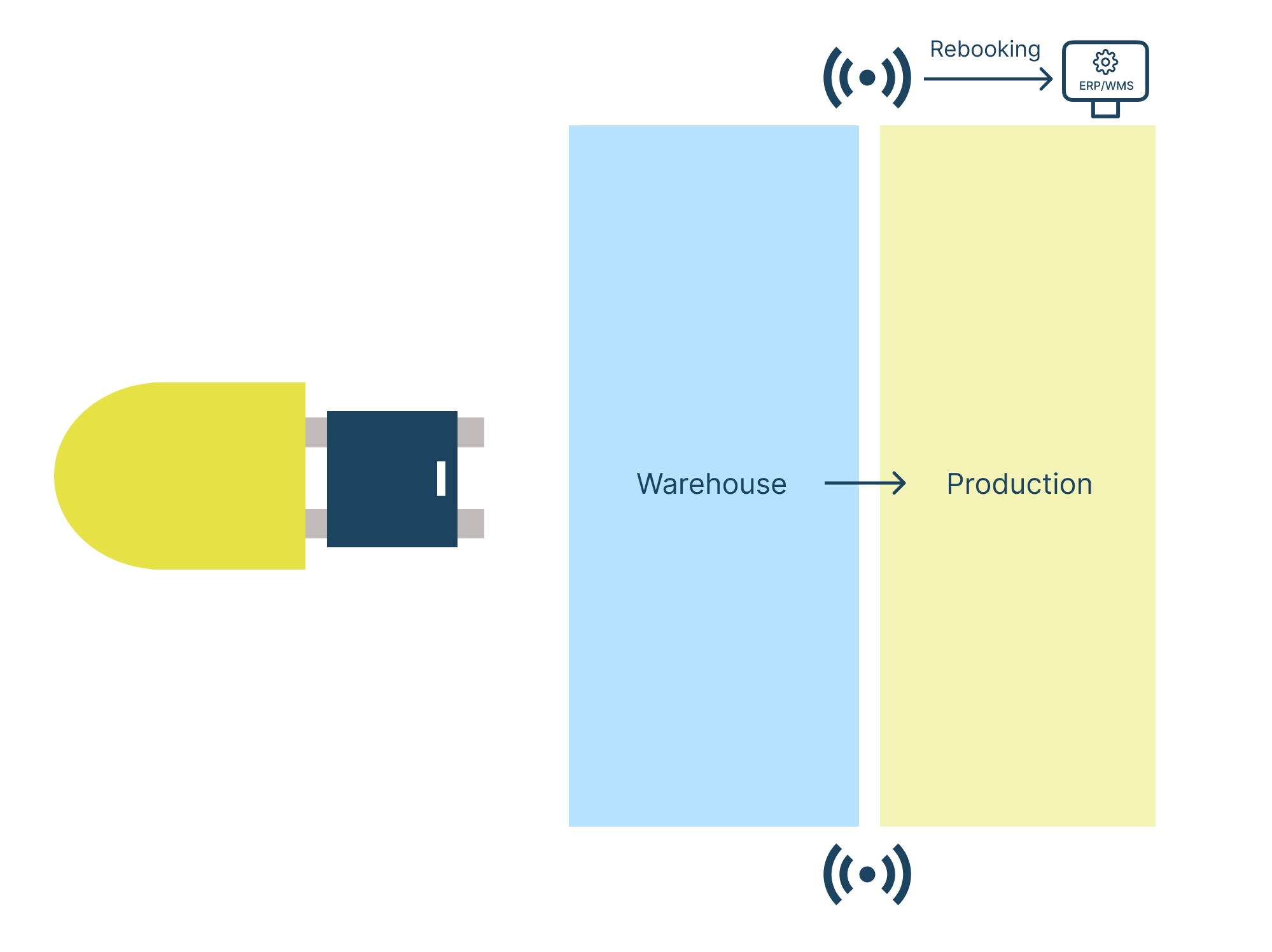
The identification of RFID transponders at an RFID gate or RFID check point cannot be used to determine how the transponder actually moves. An appropriate hardware setup is required to record the direction of movement of the transponder in addition to its identification.
By using multiple RFID antennas, several zones can be monitored using software and the movement of the transponders through the RFID gate can be determined using logic. To improve accuracy, additional sensors such as light barriers, radar sensors or ultrasonic sensors can be used, which can optionally be positioned on each side of the gate to detect and “time” the passage if required.
By filtering the signals and measuring the signal strength (RSSI), it is possible to determine whether the object is entering or leaving the gate. In addition, algorithms can be used to define the minimum time difference between reads to further improve the accuracy of directional detection. In this way, directional RFID detection enables precise monitoring of the flow of people or objects through the gate.
In summary, direction detection is based on the order in which tags are read by the antennas and can be supported by additional sensor technology or special algorithms to increase accuracy and meet the requirements of different use cases.
How does the collected data flow into third-party systems?
The recorded data is transferred to the customer-specific systems using our GRAIDWARE® middleware:
- Enterprise resource planning systems: Inventory management systems serve as a central tool for managing the movement of goods in companies. The real-time transmission of directional information using RFID technology means that stock levels are automatically updated, resulting in an accurate inventory.
- ERP systems: ERP systems are central tools for managing various business processes such as purchasing, sales, accounting and warehouse management in companies. The seamless integration of recorded data into the ERP system enables improved coordination between departments and efficient use of resources. This optimizes work processes and increases operational performance.
- PPS systems: PPS systems play a central role in the production planning and control of companies. The data obtained supports the control of the material flow by directing materials to the correct production lines. By integrating directional information, production processes are optimized, leading to a more efficient use of resources and improving overall production performance.
- BI systems: BI systems analyze the data from RFID gates to identify trends, bottlenecks and potential for improvement. These findings help companies to make informed decisions and optimize their processes. By using business intelligence, companies are able to continuously improve their operational processes and strengthen their competitiveness.
From the field: challenges and solutions
Logic adjustment to stabilize the direction detection
A high volume of traffic at certain gates posed a challenge for our customer: the use of sensor-based logic alone was not sufficient to ensure reliable direction detection. To avoid misinterpretations, we developed and implemented adapted logics that also include events from upstream and downstream RFID gates in the direction detection.
Challenges
- Recording of numerous transponders: Only those transponders that actually transit through the RFID gate must be recorded.
- Interference from nearby objects: There are other objects equipped with RFID transponders in the vicinity that must not be assigned to the current transit.
Solution
- GRAIDWARE logic for precise transit monitoring: The logic monitors the sides of the RFID gate and only assigns transponders to a transit that have actually moved through the gate.
- Efficient filtering: Transponders from objects that are only in the vicinity but have not passed through the gate are reliably filtered out by the GRAIDWARE software.
In order to be able to digitally record the change of location of goods carriers within the factory premises, RFID gates were installed at our customer's premises to enable automatic stock transfer. By using a special RFID reader, which has its own functions for monitoring several zones, direction detection was made possible without additional physical sensors. The positive and negative polarity of the RFID transponders enables the RFID reader to determine the origin of the transponder from different zones.
Switch beam technology is used here, which allows the RFID reader to control the reading area in a targeted manner. This ensures even more precise detection, as the reader can direct the reading beam in specific directions. This prevents transponders from adjacent zones from being detected and minimizes possible interference due to overlaps. As the transponders pass through the RFID gate one after the other and only one transponder is detected at a time, the zones are clearly identified without interference.
We will be happy to present solutions for your industry and your processes. Talk to the specialists for SMEs.
request now
