
 RFID gate
 Traceability
 Paperless production
 About us
 Partner
 Contact
What layers does a UHF RFID tag have?
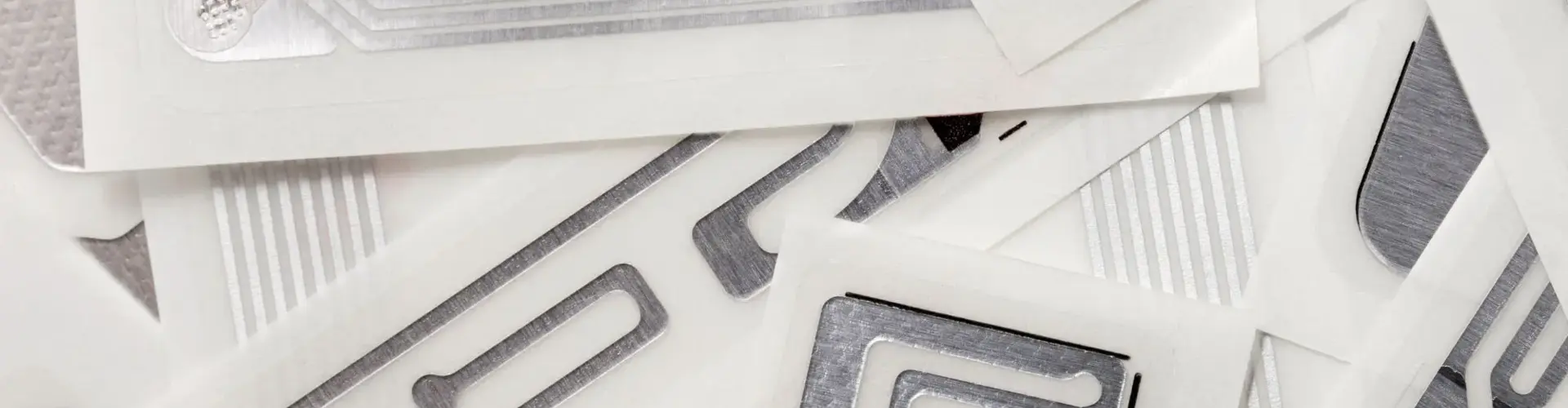
A typical UHF RFID tag consists of several functional layers that must be precisely aligned with one another.
 Viktor WagnerPublication
A typical UHF RFID tag consists of several functional layers that must be precisely aligned with one another.
The top layer protects the label from external factors such as:
The choice of material has a major impact on durability. While simple paper labels are sufficient for short-term applications, industrial applications often require robust plastic or specialty laminates.
Especially in manufacturing, logistics, or outdoor settings, this protective layer often determines the label’s actual service life.
The substrate forms the backing layer of the RFID inlay and ensures the stability and correct positioning of all components.
Among other things, it affects:
The antenna is the actual communication element of the RFID tag.
It performs two key functions:
Reading range
Sensitivity to misalignment
Behavior on metal or liquids
Data capture speed
Even small changes in shape, material, or size can significantly alter reading performance. At the same time, there is a wide selection available on the antenna market.
The chip is the “brain” of the tag. This is where information is stored and communication is controlled.
But choosing the right chip involves much more than just storage capacity.
Important factors include, for example:
Larger chips or unfavorable designs can be more mechanically vulnerable. In industrial applications, for example, labeled jars or containers may collide with one another on conveyor lines. In such cases, the chip often represents the most vulnerable mechanical point within the label assembly. In the worst-case scenario, this is precisely where failures occur.
An RFID label must therefore not only function electrically but also be mechanically suited to the application.
The adhesive is a critical success factor in many projects.
After all, even the best RFID label is of no use if it peels off the object after a short time.
Applications on the following surfaces are particularly challenging:
Depending on the material and environment, different adhesive systems must be used. Often, the right choice of adhesive is what determines whether an RFID project will function reliably over the long term.
Many RFID applications can already be implemented cost-effectively and reliably today using proven standard labels.
In most cases, this makes sense, because standard products offer:
Nevertheless, there are applications where standard solutions reach their limits:
An UHF RFID tag often appears simple on the surface. In reality, however, it involves a highly coordinated interplay of electronics, materials science, and application expertise.
The right combination of:
determines whether an RFID solution will function reliably in everyday use or cause problems early on.
That’s why it’s worth selecting an RFID label not just based on price or range, but always in accordance with the actual application.
Because that’s exactly where the true quality of an RFID label becomes apparent later on.
At SIGMA Enterprise Solutions GmbH, we support companies both in selecting suitable standard labels and in developing customized RFID solutions. We always focus on practicality, durability, and cost-effectiveness.

Viktor Wagner
Managing Director
Viktor Wagner has 12 years of professional experience as a consultant for digitalization at SIGMA Chemnitz. His expertise covers various areas, including RFID applications and the planning of RFID projects, the assessment of the feasibility of RFID projects, the design of solutions and the sale of software solutions.
We will be happy to present solutions for your industry and your processes.
Talk to the specialists for SMEs.
