RFID gate
 Traceability
 Paperless production
 About us
 Partner
 Contact


When the supply chain does not speak the same language
Anyone who works with goods flows is familiar with the problem: products are labeled differently, batch numbers are missing or unclear, and IT systems contain item numbers that look completely different in the next warehouse or at the trading partner. The consequences are errors when reordering, incorrect deliveries, time-consuming queries, and, in the worst case, expensive recalls.
In short, without uniform standards, things get very confusing.
The chaos is particularly evident when many players interact in a supply chain. From the manufacturer/producer to the logistics service provider to the distributor and end consumer, there are many hands involved. Everyone uses their own formats and systems, which are often incompatible with each other.
GTIN as the DNA of every product
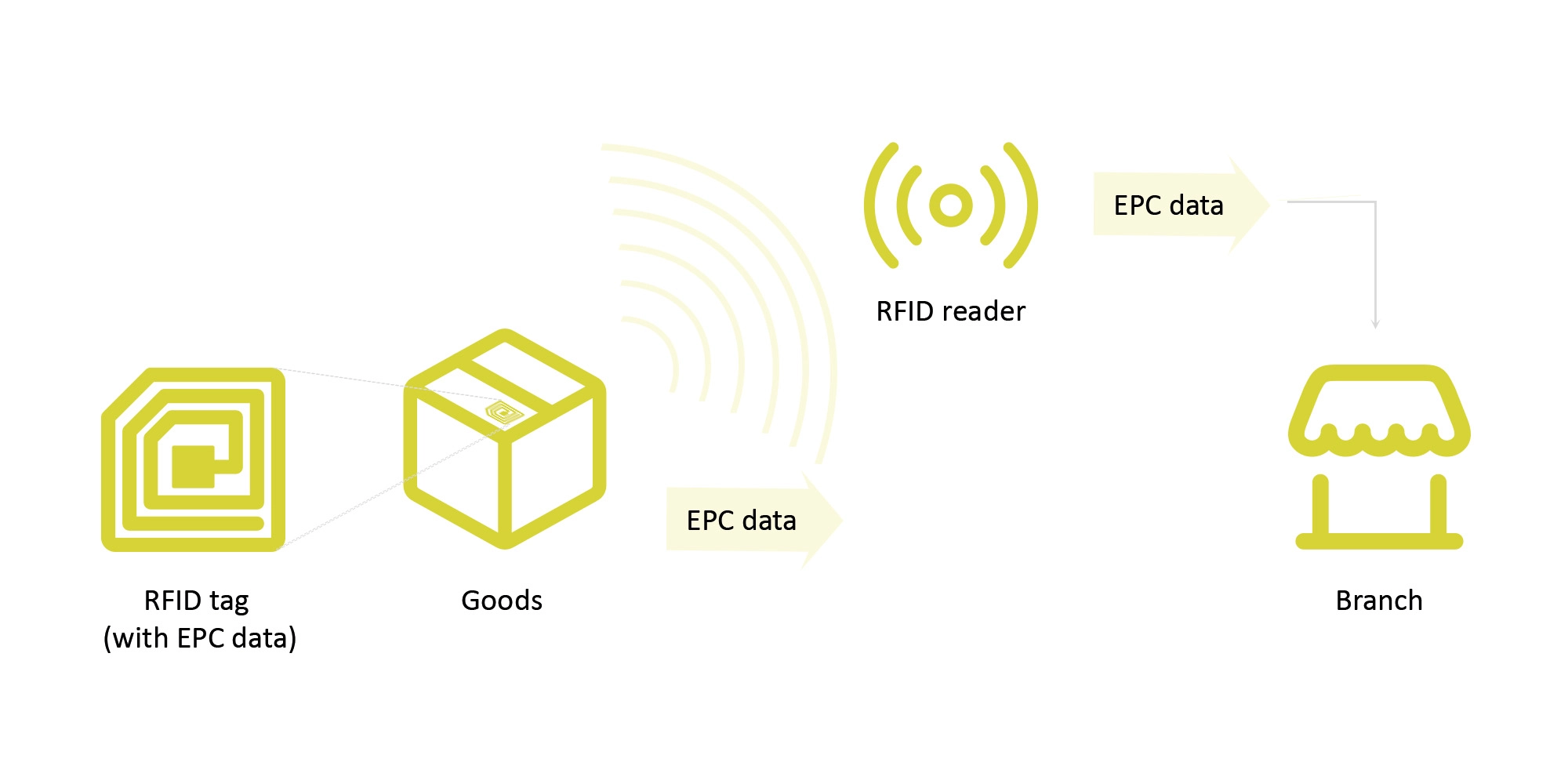
The solution is the GTIN (Global Trade Item Number), a globally unique key that assigns each product a kind of “digital DNA.” It is anchored in the GS1 EPC standards and forms the basis for barcodes and RFID tags.
A GTIN can have 8, 12, 13, or 14 digits, depending on the industry and application. Breaking it down, we get:
- GS1 prefix – a code that indicates the country or organization of the company.
- Company number – uniquely assigns the product to a specific manufacturer.
- Item number – identifies the specific product within the range.
- Check digit – used for error detection during scanning.
This structure guarantees that every toothbrush, every bottle of juice, or every medication worldwide is uniquely identifiable, regardless of who scans it or which system it ends up in.
From theory to practice
food producer
A producer packs fresh goods into cartons. Without a standard, the carton labels would be formatted differently depending on the plant or logistics service provider. With EPC RFID and GTIN in the tag, the system automatically recognizes which product it is, including shelf life and batch.
The result: fewer mix-ups, less waste, and faster response times in recalls.
Wallpaper supplier
A wallpaper manufacturer faces a typical challenge: its product range comprises several thousand items that differ only minimally in appearance. Even with just ten different shades of blue, mistakes occur regularly. In order picking, in the warehouse, or when customers place repeat orders. These mix-ups lead to unnecessary returns, increased effort, and additional costs.
With the introduction of an RFID system, individual wallpaper rolls can be clearly identified by radio frequency. Warehouse employees receive immediate feedback if they accidentally pick the wrong item. The visual inspection that was previously necessary is no longer required, and incorrect deliveries are drastically reduced.
There is also added value for the customer: thanks to unique identification in accordance with the GS1 standard (e.g., via the GTIN), items can be correctly entered into the respective system. Different number ranges or duplicate master data are now a thing of the past. This means that both manufacturers and customers benefit from smoother processes, fewer errors, and higher customer satisfaction.