RFID gate
 Traceability
 Paperless production
 About us
 Partner
 Contact
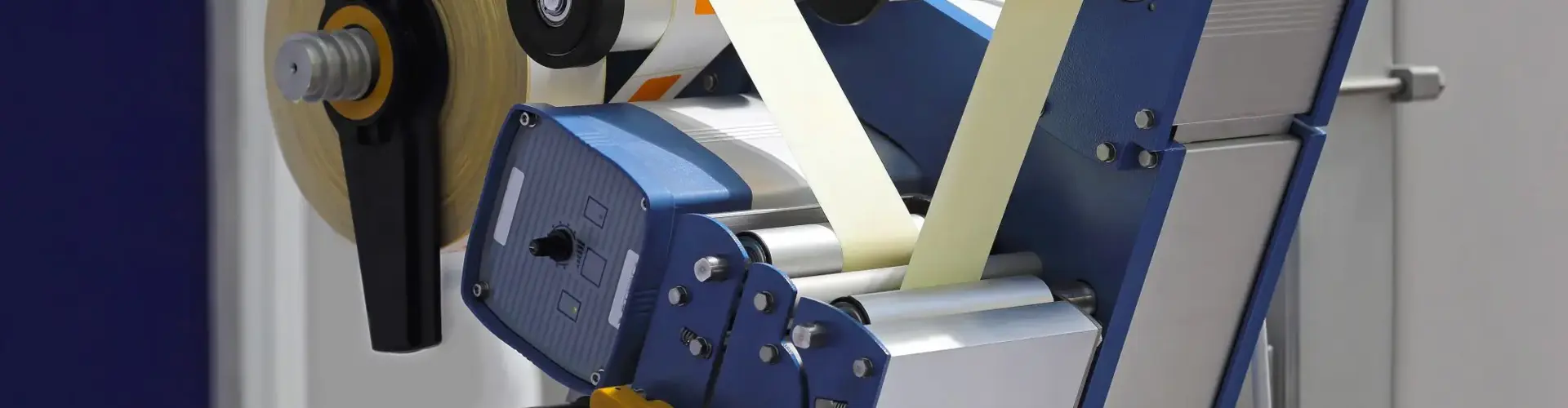

When products need to be labeled, precision is key. Many companies are familiar with the process: an employee takes a label, applies it, checks that it is positioned correctly, and then repeats the whole process. However, manual application has two major weaknesses:
- Prone to errors
- Loss of time
Labels slip, are stuck on crookedly, or placed incorrectly—and every single mistake costs money. Added to this are ergonomic stresses for employees, especially when performing monotonous repetitive tasks. It is even more difficult when RFID applications require smart labels to be affixed precisely. Incorrect affixing then leads directly to a system that is prone to errors.
Automatic application offers an elegant solution here:
- Faster than any hand movement
- More precise than any visual estimate
- More reliable for large quantities
In the right environment, it not only ensures consistently high quality, but can also significantly streamline processes.
Where manual application remains important
Of course, there are industries in which fully automated labeling is not practical.
Examples:
- Food industry: Containers such as cheese wheels, wine bottles, or special containers are often labeled, and their shape or surface texture varies slightly. This requires a certain amount of finesse.
- Pharmaceuticals and laboratories: For small batches or particularly sensitive materials (e.g., glass vials), manual application remains the standard in some cases, as flexibility is more important than speed.
- Luxury goods industry: Exclusive wines, fine spirits, and custom-made products are often deliberately labeled by hand to emphasize their value.
Automation is certainly an interesting option in these industries, but it often only makes economic sense once a certain production volume or degree of standardization has been reached.
Where machines have to take over labeling
On the other hand, there are areas where manual labeling is no longer an option—simply because of the large quantities involved:
- Automotive industry: Components often need to be uniquely identified in their hundreds of thousands – from airbags to seat rails.
- Electronics manufacturing: Circuit boards, components, housings – RFID or barcode labels must be applied accurately and quickly.
- Plastics and injection molding industry: With production volumes of several million units per year, a manual process is simply no longer affordable.
Here, high-performance application units or even fully integrated robot solutions are standard.
How is automatic application carried out? – Overview of methods
There are different technologies depending on the application:
- Tamp-on (pressing): A label is pressed precisely onto the product using a stamp.
- Blow-on (blowing): The label is “blown” onto the product without contact – ideal for sensitive surfaces.
Wipe-on (rolling): The label is gently rolled onto the product as it passes by.
Pick & place systems: Robot arms pick up labels and place them precisely – often combined with camera systems for position detection.
The more precise the repeat accuracy and the more standardized the product, the easier and more economical the automation.
Challenges during implementation
Automatic application works best when certain conditions are met:
- Standardized parts: The more identical the parts, the smoother the process.
- Clear positioning: Products should always be provided in the same orientation and at the same location.
- Robust labels: The labels must be suitable for the application method (e.g., flexibility for blow-on processes).
- Sensible integration: The application unit should be seamlessly integrated into the production or packaging line.
Good advice and a tailor-made concept are the keys to success here.
Current use case: injection molding production
The benefits are particularly clear in the plastics and injection molding industry:
Here, several million parts are often produced each year. Typical examples include housings, clips, brackets, and connectors.
Manual labeling would not only be uneconomical—it would be practically impossible.
That is why fully automatic application systems are used almost exclusively for such quantities in order to keep costs low and ensure maximum process reliability at the same time.
SIGMA offers comprehensive system consulting, experience, and a strong partner network to find the optimal solution for every application.
Those who want to take the step toward automation don't have to figure everything out on their own—sometimes a good conversation is all it takes to discover the right path.