RFID gate
 Traceability
 Paperless production
 About us
 Partner
 Contact
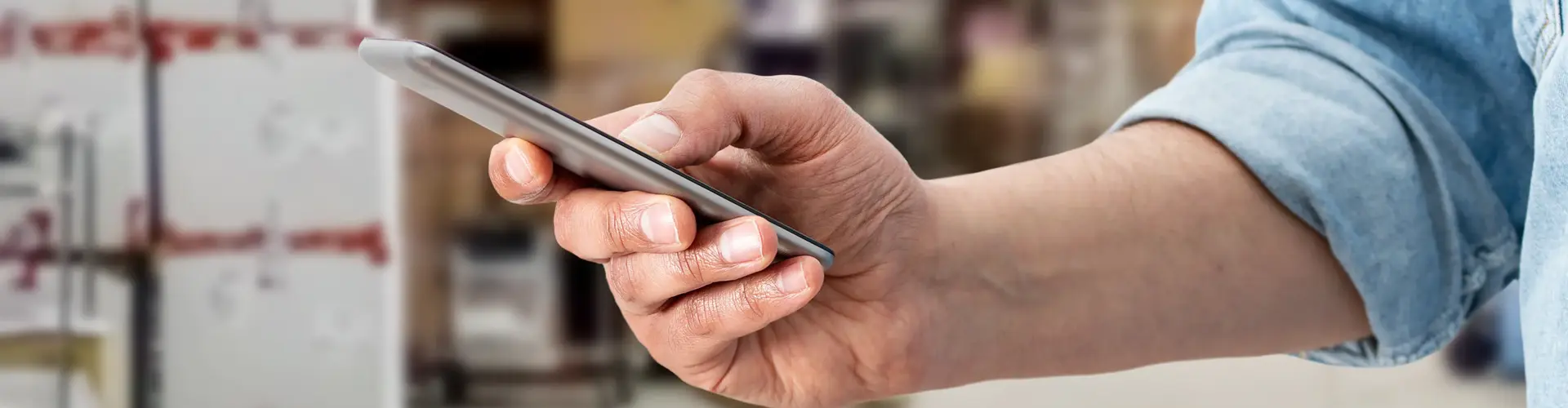

RFID technology in transition: compact hardware for maximum flexibility
RFID technology has undergone impressive development in recent years. Whereas it used to be necessary to install large stationary readers or rely on bulky handhelds, today's technology offers much more flexible solutions. Thanks to ever smaller hardware, UHF RFID can now be used in almost any environment - even in confined production or storage areas. But probably the most exciting development is the integration of UHF RFID into smartphones.
The new UHF technology should not be confused with NFC RFID technology, which is already integrated into many smartphones for payment processes and other near-field communication applications.
RFID antennas in smartphones: the future of mobile data collection
Depending on the type, modern industrial smartphones now have the option of integrated UHF RFID readers. These devices combine the advantages of conventional barcode scanners with RFID technology and are also robust enough for industrial applications. Equipped with high protection classes, they are dust and water resistant and therefore suitable for harsh environments.
The possibilities for using these smartphones in an industrial environment are diverse. While previous scanners often relied on an additional antenna to read RFID tags, modern smartphones offer a fully integrated solution. A decisive advantage: if an RFID tag cannot be read, it is still possible to scan the barcode. However, this only works if the tag is visually visible.
Invisible tags and other use cases
In many applications, optical identification is not possible. Tags that are used inside foam parts in vehicle construction or in window foams, for example, cannot be scanned using barcodes. Plastic sheathing after the injection molding process also makes optical detection impossible. This is where the true strength of RFID becomes apparent: contactless identification also works with invisible tags.
However, there are also challenges. The compact design of smartphones limits the size of the antenna, which has an impact on the range of the readers. While classic RFID handhelds often offer a range of several meters, smartphones are usually limited to around one meter. In many applications, however, this is completely sufficient and enables fast and convenient data capture.
Use case: efficient and tamper-proof maintenance processes with UHF RFID smartphones
In many service and maintenance processes, barcodes are currently still used to identify test objects such as water meters, electricity meters or fire extinguishers. Technicians scan these codes to document inspections and maintenance work. However, this method involves a considerable risk of manipulation: as barcodes can simply be captured by a photo, it is theoretically possible to approve a test remotely without actually having been on site.
This is where the use of UHF RFID-enabled smartphones comes in. Unlike barcodes, UHF RFID transponders require physical proximity to the test object in order to be read. This ensures that a technician must actually be on site to carry out the maintenance process correctly. This not only prevents tampering, but also improves the traceability and documentation of maintenance work.
UHF RFID technology also offers considerable efficiency benefits: Technicians no longer have to specifically search for a barcode or align it correctly, as UHF RFID transponders can be detected without contact and from a greater distance. This makes inspection processes faster, more reliable and safer.
The integration of UHF RFID into smartphones also eliminates the need to carry separate RFID handhelds, which further simplifies the implementation and use of this technology for maintenance companies.
The future of UHF RFID in smartphones
Whether RFID smartphones will establish themselves as the standard in the long term is likely to be decided primarily in the retail sector. User-friendliness plays a decisive role here: using a compact smartphone instead of a bulky handheld could significantly increase convenience for employees. However, there are also numerous potential applications in industry - from inventory to process optimization.
Conclusion: RFID technology is mature and ready for use
RFID technology has developed enormously in recent years. Today, there is suitable hardware for almost every application - from powerful handhelds with a long range to compact smartphones with an integrated RFID antenna. Companies that now rely on these technologies can make their processes more efficient and transparent. Now is the ideal time to benefit from the developments of recent years.