RFID gate
 Traceability
 Paperless production
 About us
 Partner
 Contact


The digital product passport is getting closer
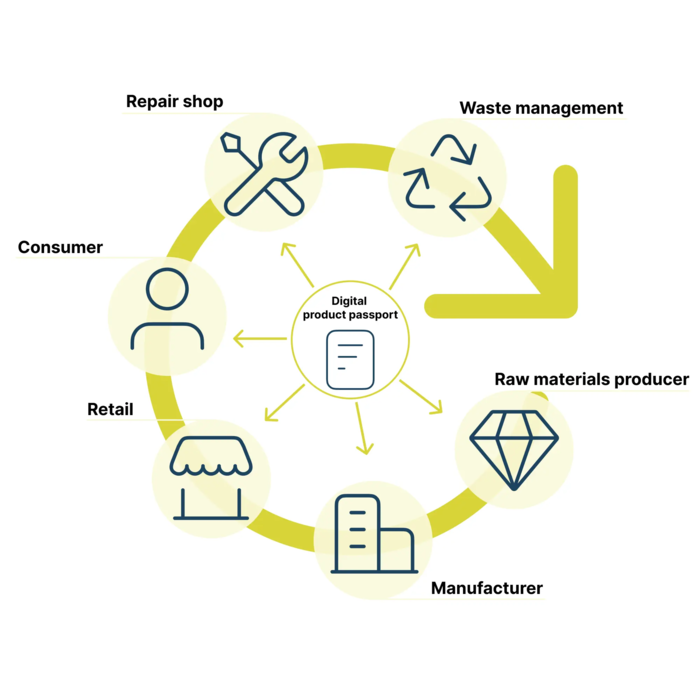
The Digital Product Passport (DPP) is a key EU tool for promoting the circular economy. Its aim is to provide structured and transparent information throughout a product's entire life cycle – from raw material extraction to recycling. The first EU requirements will become binding in 2027, posing new challenges for many manufacturers. At the same time, early practical examples show that implementation is feasible and that both companies and consumers can benefit. Digital labeling plays a key role here, particularly through technologies such as RFID, which enable reliable product identification.
What is the Digital Product Passport?
The digital product passport is essentially a structured data set assigned to a product. It contains, among other things:
- Material composition and origin
- Production information
- Repair and maintenance instructions
- Recycling and disposal information
The European Union plans to gradually introduce the Digital Product Passport as a mandatory requirement. From 2027, this will apply to batteries, electronics, and textiles, among other things. From 2030, other industries such as furniture, tires, and vehicles are to follow.
For the Digital Product Passport to work in practice, there needs to be a robust and clear link between the product and the data set.
Fashion & Textiles: Transparency becomes a brand promise
In hardly any other industry is change as visible as in the textile and fashion industry. Clothing manufacturers recognized early on how important digital product information would become. Major luxury brands such as Chloé, but also international brands such as H&M and Adidas, are already pursuing clear strategies around the digital product passport.
The focus here is primarily on traceability for end customers. Information about the manufacturing process, the materials used, and recycling options is made transparently accessible. What used to be “hidden” is now part of brand communication.
Mandatory documentation not only helps to comply with EU regulations. It also enables buyers to engage more consciously with a product and better understand the environmental and sustainability aspects of their fashion brand. Transparency creates trust and is increasingly becoming a trademark.
Sports & Leisure: A digital resume for products
Exciting success stories are also emerging in the sports and leisure sector. A bicycle manufacturer has started to label its frames with forgery-proof NFC stickers. This gives each frame a unique identity and a digital history.
Customers can view this directly when making a purchase:
Information on manufacturing, maintenance, and use is available centrally.
Such data is necessary anyway, especially in the high-priced used market, in order to prove the quality and value of a bicycle to the buyer.
The digital product passport was therefore not an additional expense for the manufacturer, but a logical next step. The data is more easily accessible, traceable, and trustworthy, strengthening confidence in both the product and the brand.
In this bicycle price segment, such proof was already a given.
But which technology is actually the best?
The technological implementation of the digital product passport is deliberately flexible. Depending on the application, DMC codes, QR codes, NFC, UHF RFID, or combinations thereof are used.
If a manufacturer wants to make the DPP transparent and easily accessible to end customers, the QR code is usually the first choice: every user can access the information directly with their smartphone, sometimes even without an app.
However, as soon as the Digital Product Pass is required to do more than just provide information, such as genuine traceability in production and logistics, visual codes quickly reach their limits. In these cases, UHF RFID tags are particularly well suited. They enable automatic recording, mass scanning, and real-time transparency along the entire material flow. For the end customer, a QR code can still be applied in parallel. Technologies are not mutually exclusive; they complement each other.
Typical advantages of RFID in relation to DPP:
- Unambiguous identification of a large number of products at once (bulk readings)
- Automated data updating along the supply chain
- Durability even with high requirements
- Storage of process and status data (e.g. machine data)
An RFID transponder thus becomes the digital DNA of a product—and carries all the information required by the DPP.
The specific implementation depends heavily on the industry, product, and process. There is no one right way to do it. But despite all the diversity, there is one common denominator for almost all companies:
If the DPP is required by the EU anyway and a traceability solution must be implemented, why not use this effort directly for your own processes?
Many companies are only now realizing the potential that has remained untapped in terms of transparency, efficiency, and process reliability. The digital product passport is thus suddenly transformed from a pure compliance issue into a real internal value driver.