Digitale Behälterwäsche
Publication
Update
Traceability

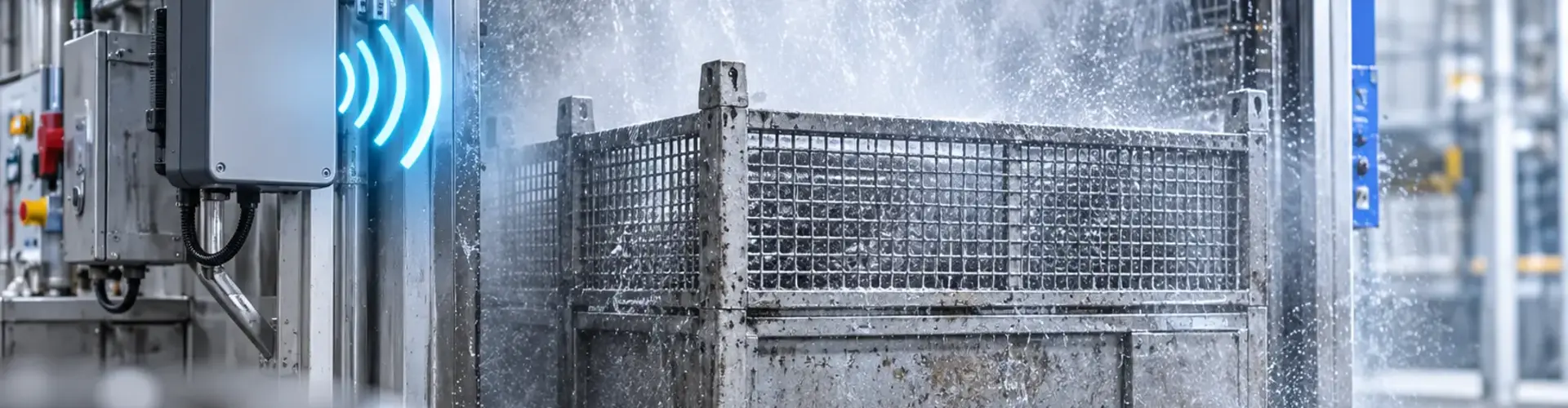
As containers pass through the wash tunnel, UHF RFID automatically records each wash cycle—ensuring complete documentation and clear container status.

Reusable containers, crates, bins, and other load carriers remain in circulation for long periods of time across many industries. To ensure they can be used safely, hygienically, and reliably over the long term, regular cleaning is an integral part of the material cycle.

In industrial washing systems, containers are often treated with water, cleaning chemicals, and high pressure. Depending on the industry, this is not just a matter of cleanliness. Cleaning can be crucial for product safety, hygiene, occupational safety, and a smooth logistics process.

In the food industry in particular, there are high standards for hygiene and traceability. Standards such as the IFS set corresponding requirements for processes and their documentation.

At the same time, dirty or sticky crates can cause disruptions in automated warehouse systems. With IBC containers, there is an additional safety concern: Residues of hazardous substances can pose a significant risk to employees.

The question is therefore not just: Was the container washed?

But also: When, how often, and which container was washed—and has it even been approved for the next process?


Documentation without requiring any additional effort from employees

Many companies already document the washing process today. However, this often involves additional manual effort.

For example, a forklift operator transports a large container to the washing station. If a form must then be filled out, a barcode located, or a container scanned manually, this creates an extra step that adds no value to the actual material flow.

This is exactly where digital container identification with UHF RFID comes in.

The container is equipped with a rugged RFID transponder bearing a unique identifier. An RFID reader automatically recognizes the container as it passes through the washing line. The washing process is documented in GRAIDWARE without requiring the employee to perform any additional manual data entry.

An everyday process is thus automatically converted into a digital data record:

Container detected

Washing process recorded

History Updated

Status documented

GRAIDWARE turns the container into a digital object

With GRAIDWARE middleware, containers can be represented as independent objects in the system and uniquely linked to an RFID tag.

In addition to the individual container number, information such as the manufacturer, container type, design, or other customer-specific characteristics can be stored.

This creates a digital identity for each load carrier.

If the container is subsequently detected at an RFID reader, GRAIDWARE can uniquely assign the transaction and document it in the container history. Every wash cycle becomes traceable, and the container’s usage history remains transparent.

This not only ensures complete documentation; it also provides companies with a data foundation for maintenance planning, service life analysis, and optimization of their container fleet.

RFID Right at the Car Wash

A particular challenge is RFID tracking directly at industrial washing systems.

Water, cleaning chemicals, high pressure, and high temperatures create demanding operating conditions for RFID systems. At the same time, the identification process must function reliably, even though containers are moved quickly through the system—sometimes in different positions.

SIGMA allows for such challenging industrial environments to be accommodated. Both the selection of a suitable industrial transponder and the positioning and design of the RFID reading technology are tailored to the specific system.

The RFID transponder must be able to withstand the environmental conditions at the container on a long-term basis. The reading station, in turn, must be designed and installed in such a way that reliable identification is possible even under real production conditions.

Different Containers and Transponders in a Tracking Software Program

In practice, a container fleet is rarely homogeneous. Different sizes, materials, designs, and areas of application often entail different requirements for RFID tagging.

GRAIDWARE can map various container types and number ranges within a single system structure. This allows even large and heterogeneous container inventories to be managed centrally.

This enables end-to-end identification, from the individual container to the entire fleet.

Manual washing processes for special containers can also be integrated. Identification can be performed automatically, for example, using appropriate workstation antennas or desktop readers.

More Than Just a Wash Log: Digital Container Status

The digital container history offers yet another key advantage: In addition to wash cycles, GRAIDWARE can also manage status information.

For example, a container can be locked due to damage, deformation, or another defect. Although it is supposed to be sent for repair, it must not accidentally re-enter the regular production process.

The status is set to “blocked” in GRAIDWARE accordingly.

If the same container is later detected at an RFID reading station, the system can take the stored information into account. Instead of simply routing the container as “washed,” alerts can be triggered automatically.

Depending on the system design, this could include, for example, warning messages, a visual signal via a red light, or a display on a terminal.

In this way, RFID identification becomes an active component of quality and process management.

Digitally Upgrade Existing Systems

Digitizing container washing does not necessarily mean replacing an entire system.

Even existing washing lines can become more transparent by retrofitting them with RFID identification. The key is finding the right combination of robust RFID hardware, suitable antenna and reader technology, and software that effectively integrates the collected data into the company’s processes.

With GRAIDWARE, this information can be consolidated centrally and used for further process control.

The result is a washing process that not only physically cleans but also digitally documents which container was cleaned, when, and how often, as well as its current status.

From the car wash to complete container transparency

The automatic tracking of wash cycles is thus much more than just a digital alternative to paper logs.

It lays the foundation for end-to-end transparency across the container fleet:

  • Each container has a unique digital identity.
  • Wash cycles are automatically documented.
  • The complete container history remains traceable.
  • Maintenance and service life intervals can be planned more effectively.
  • Locked or damaged containers can be identified.
  • Hygiene and documentation requirements can be systematically supported.
  • Record-keeping to ensure compliance with regulatory requirements.
  • Employees are relieved of manual data entry tasks.

Digital documentation does not become an additional step in the process, but rather an invisible part of the existing material flow.

Viktor Wagner

Viktor Wagner

Managing Director

Viktor Wagner has 12 years of professional experience as a consultant for digitalization at SIGMA Chemnitz. His expertise covers various areas, including RFID applications and the planning of RFID projects, the assessment of the feasibility of RFID projects, the design of solutions and the sale of software solutions.

More about the author

Talk to us!

We will be happy to present solutions for your industry and your processes.
Talk to the specialists for SMEs.

request now