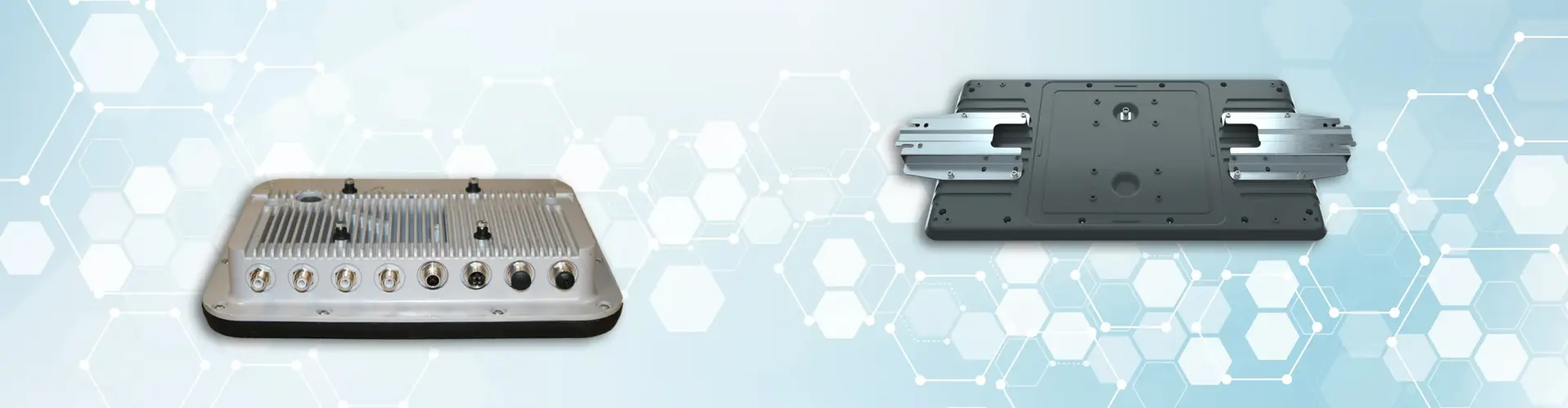
Antennenanschlüssel Detail
Hardware

Learn how the right antenna connector can be a decisive factor for your system stability.

Small connectors with a big impact

Although RFID antennas and readers are at the forefront, an inconspicuous factor often determines longevity, reliability, and performance: the antenna connection.

Many of the connectors commonly used today, such as SMA and TNC, which were developed for high-frequency technology and radio applications, have been around since the 1960s. In the UHF RFID environment, SMA and TNC in particular have established themselves as the standard, supplemented by special variants such as N-Type and FAKRA.


What types of connections are available in UHF RFID?

  • SMA (SubMiniature Version A)
    • Compact screw connector
    • Widely used in medium-sized readers and antennas
  • TNC (Threaded Neill-Concelman)
    • Robust screw connection, vibration-proof
    • Popular in industrial applications and outdoor use
  • N-Type
    • Larger, weatherproof, and suitable for long cable runs
  • FAKRA
    • Color-coded, lockable connectors from the automotive industry
    • Resistant to shocks and incorrect connection
  • U.FL / MMCX
    • Flat assemblies, more suited to embedded solutions

SMA vs. TNC: a comparison of the two showmakers

Criterion

SMA

TNC

Weather resistance

Sufficient for indoor applications

Outdoor certified, better seals

Size

ery small, saves space

Larger, heavier, but more stable

Fastening

Quick to assemble, but fine threads

A little more effort, but a secure fit

Examples of use

Compact readers, laboratory scenarios, indoor spaces

Industry, vehicles, machine environments, outdoors

Maintenance

May come loose during vibration

Low maintenance, durable even under load

Practical insight: RFID installations in vehicles

When equipping vehicle interiors with RFID technology (e.g., for monitoring transported goods), strong vibrations and shocks occur.

  • SMA connectors quickly become loose, requiring regular readjustment and maintenance.
  • TNC connectors, on the other hand, ensure a reliable connection, even after many trips and heavy loads.

Connection variety and delivery logistics

Many antenna manufacturers offer their models with different connection types and cable lengths. This sounds flexible, but in practice it leads to stumbling blocks:

  • Cable availability: Some connector types are only available in certain cable lengths. Special lengths have to be manufactured.
  • The longer the cable, the greater the signal loss. Not every cable length is technically feasible.
  • Attenuation: Certain connectors also come with a matching cable type. Different cable types vary in their attenuation, meaning that not all of them are suitable for longer cable lengths.
  • Cost-effectiveness: Standard connectors mean short delivery times and low prices. Special connectors can delay projects and increase costs.

SIGMA expertise: avoiding mistakes, securing projects

In some cases, choosing the right antenna connection can also determine the success of a project.

SIGMA Chemnitz offers:

  • Planning & use case analysis
  • Product recommendation & variant comparison
  • Project-specific cable assembly, if necessary
  • System commissioning & support

With our experience, you can avoid typical mistakes that can arise in the details of hardware planning. We design the entire system, right down to the “inconspicuous” antenna connector.

Viktor Wagner

Viktor Wagner

Managing Director

Viktor Wagner has 12 years of professional experience as a consultant for digitalization at SIGMA Chemnitz. His expertise covers various areas, including RFID applications and the planning of RFID projects, the assessment of the feasibility of RFID projects, the design of solutions and the sale of software solutions.

More about the author

Talk to us!

We will be happy to present solutions for your industry and your processes.
Talk to the specialists for SMEs.

request now